Jack

Jack
Showing posts with label Incubator. Show all posts

Saturday, May 10, 2025

IT HAS BEGUN!

In prepping for our annual Chickam webcast, I run the incubator and associated equipment for at least a week. This year was no different, and everything had been purring along beautifully...
...until three days before I was due to set the eggs in the incubator.
 
That's when my trusty, 8 year old ReptiPro incubator suddenly stopped heating.
Despite opening it up for a good cleaning (and finding nothing appeared amiss), it refused to be resurrected. Well and truly borked. And the ReptiPro company no longer exists, haha.
 
Okay, I find one over at Vevor for a reasonable price that looks identical to my old ReptiPro, and get it ordered. But this means it will also be subject to a week-long test run, so our original Chickam start date & hatch date are out the window. 


Luckily it performs well, despite a few kinda big issues, cool chicken-disco blue light aside.
 

See that black thing on the top? That's a madly spinning, UNCOVERED fan. As you stand in front of the incubator it is below your eye level...and easy to forget it's there. Perfect for taking the hide off the back of your hand when you reach in there, haha.
I know this, because...
Yeah.
 
The exposed cord running from it down to the built-in fan is...odd, and no doubt will get pecked by curious chicks. Also, the two racks we always used in the ReptiPro to hold eggs are impossible, because (as revealed in the manual, no less!) there is a FIVE DEGREE TEMPERATURE SPLIT  BETWEEN THE TWO RACKS.
I tested it, and sure enough, one rack ran at 99.5, the other at 104.5 
Chicken eggs require a constant incubation temperature of 100.5, haha.
 
We must use the space between the upper and lower racks. This means we can only run ONE rack of 12-15 eggs, depending on their size.
But by far the worst thing is, there's no cord notch in the frame that the ReptiPro had--I cannot use my trusty water weasel/temperature probe combination to mimic an egg and give me a dead-on temperature reading inside an egg. And I don't have time to cut a cord notch in the brand-new incubator (for extra fun, the manual says there IS a notch. It lies).
*sigh*
 
Okay, run with what ya got. So here it is, today we started 15 eggs from our flock! In an effort to get eggs from certain hens, the kid and I spent two solid days sitting out in the coop, Johnny-on-the-spot catching the girls laying eggs...with so-so success. That's why you'll see names written on eggs--the ones with a question mark means we are only 90% certain of mama.


I'll candle them in 10 days to see how many embryos we have and remove any duds. Hatch day *should* be Saturday, May 31st - Sunday, June 1st.
 
When the first egg pips, we'll start our YouTube webcast here:

Friday, April 2, 2021

Chickam Candidates!

On March 13th we set 36 eggs in the incubator, and at 13 days in, I candled them. We had 26 eggs with embryos, with another 2 eggs with shells too dark to be sure.


Three days before hatch, we moved the eggs to the bottom of the incubator, crossed our fingers and waited!


Now to see what we get! I'm especially curious about the large, white eggs--possibly from our white Leghorn hen, Boombox.

Saturday, March 10, 2018

Countdown To The 10th Anniversary Of Chickam!

Today I set eggs in our good ol' ReptiPro incubator, in three weeks there should be chicks!

This is a landmark year--2018 marks the 10th year we've been hosting Chickam, our 24/7 webcast of the hatch of baby chicks and their subsequent 8 weeks of life.  We've been hatching chicks since about 2001, but only started the webcast in 2008.

Since this is both a special year, and Easter (our traditional hatch day) falls on April 1st this time around, we decided to hatch some special breeds--time for some feathered silliness!

So I shopped around on the Internet, and in addition to hatching some of our own eggs I got some Dark India Cornish Rock Bantams, some Polish (possible Frizzles) and Brahma mixes and Bantam Cochin (more possible Frizzles) mixes.  With Frizzles you don't know at hatch if you have a Frizzle or not--you have to wait until real feathers start to come in to spot the tell-tale curl to the feathers.  And since wing feathers come in first on a baby chick, that's where any frizzling will show up first.

Here are the eggs!

First up, some of the shipped eggs.  On the right, the large white eggs at the bottom are the 3 Polish eggs--speckled, buff, silved laced and gold laced are the colors we may get. At the top right are the 5 Brahma/Heavy breed mix eggs, they are more of a who-knows-what-you'll-get variety.
On the left are the 8 bantam Cochin eggs.  The 7 eggs marked 'MF' have a MilleFleur coloration, the one marked 'CB' is a calico color.  The egg marked 'Wiggles' is one of ours that happened to be in the picture. We decided later that it was likely NOT laid by Wiggles (a Belgian d'Uccle) but is more likely to have been laid by Popcorn, who is a bantam Cochin mix hen.

Next are the 9 Dark India Cornish Bantam eggs.  The one at the top was sadly broken in shipping, so we ended up with 9 instead of 10.  I also candled the others to check for cracks and saw some detached air cells (a very bad thing) in some of the eggs, which points to rough handling in shipping. I'm hoping for the best with these...

Finally, 13 eggs from OUR girls!  We always include some of our own eggs since shipped eggs have a notoriously low hatch rate due to the inevitable rough treatment they receive from the US postal service.
The 'Wiggles' egg is in there, and not pictured is a last-minute addition of a tiny bantam egg, likely from one of the d'Uccle girls.  But I went for a cross-section of our flock in this collection--some large breeds, some bantams, and everything in between.

We have a total of 39 eggs that I started today in the incubator. In addition to each egg getting a number and a breed mark when I knew it (no breed marks for our eggs, 'I' for the Dark India Cornish, 'P' for Polish, 'B' for Brahma mix and 'CB' and 'MF' for the bantam Cochins) I marked an X on one side and a O on the other, and started them with the X side up. Over the next three weeks I will turn the eggs 5 times a day, from X side up to O side up at each turn.
The device at the top right is a hygrometer, is measures the humidity in the incubator, which needs to be 50% for the first 18 days, 65% for the final three days. The cord on the left leads to a thermometer outside the incubator--the probe for the thermometer is stuck inside a glitter pink Disney princess water weasel toy--the water weasel simulates an egg, the probe gets stuck inside the thing to get you an idea of the weather INSIDE an egg, giving you a better hatch! You want a reading of 99.5 degrees inside the eggs.  At the very bottom of the incubator is a dish with water in it to provide humidity--the marbles are just so when the chicks hatch, they don't soak themselves or drown in the water dish.  I could have added the marbles later on, but wanted to get everything up to temperature at the beginning and not have to mess with it later.  The thin black silicone mat on the floor of the incubator will give the hatched chicks needed traction for the few hours they are drying out in the incubator so that they don't develop Spraddle Leg.

Ten days from now, I'll candle each egg.  Eggs that haven't started to develop an embryo will get pulled from the incubator, those with developing embryos remain.  If an eggshell is too dark to see through when candled (like the dark green and dark brown eggs), they stay in the incubator.  Usually only about half of the shipped eggs develop at best, but we tend to get about an 80% or better development on our eggs.

Chicken eggs typically hatch after 21 days of incubation, with bantam eggs sometimes hatching 1-2 days early-so I suggest you check the UStream Chickam channel starting on March 29th.  If all goes well, Chickam will be the weekend of March 31st-April 1st!  The cam isn't started until the first egg pips, so if you tune in to the UStream channel linked above and see EGGS, it means the hatch has begun!

Fingers crossed for lots of embryos in 10 days and a bunch of little April Fools in 3 weeks!

Wednesday, April 12, 2017

And Here We Go!

So I went out the the incubator & brooder box, getting final touches ready...

Little things, like making sure Club Flamingo is set, along with a cuddle buddy for the chicks that the kid donated...


And I did the final turn of the Lot B eggs, placing them down on the floor of the incubator to join the Lot A eggs, plus adding more water to bring up the humidity to 65%.

And damned if I didn't see our first pip, on #15!  It's hard to see, but it's on the upper left on the shell and looks like a little half circle.  The egg is rocking back and forth and being quite active.  No other pips as yet, but several other eggs have been moving!


#15 will probably hatch in about 6-8 hours...maybe a bit more, but those banties are quick little stinkers!  When any egg is close to hatch, we'll start the cam!

Tuesday, April 11, 2017

Lockdown Day!

And yeah, even though with the ReptiPro incubator you don't actually do a lockdown (where you stop turning the eggs and do not open the incubator again until the hatch is done) on the eggs, day 18 of incubation will forever be 'lockdown day' to me.  With the ReptiPro you simply stop turning the eggs, but do open the incubator 5 times a day to let fresh air in.  So today was lockdown day for Lot A, the first group of eggs.  Lot B will join them tomorrow, meanwhile I'm still turning Lot B today.

We ended up with 13 embryos, 11 of our eggs and only 2 of the Dark Cornish that made it to this point.  To tell the truth, given the age and condition of the rest of the mail-order Dark Cornish eggs, if either of the chicks makes it and is healthy, it'll be a miracle.

But here they are!  Lot A has been moved down to the bottom of the incubator, where the humidity will be raised to 65%.  Banty eggs in front since I suspect those little stinkers will hatch first, probably even early.

Maybe even today... 
No pips or peeping yet, but some of the eggs are rocking when I talk to them!

My little homemade water weasel performed just fine and is still doing it's job...


As for the brooder box, it's been raining so non-soggy boxes were not to be found--but my husband found some fun raw materials for me to construct it out of...
It's a movie advertising display!

We don't want the glossy surface on the inside with the chicks, so here's the end product:

The brooder box will get the finishing touches of hay, heat lamp, food/water dishes, etc. today.  But we're ready!


I'm actually ahead of the banty eggs hatching FOR ONCE, HA!

I will update on the Chickam Twitter page when the hatch begins, and you can watch it on our UStream channel, here--if you tune in and see eggs, that means the hatch has begun!

Tuesday, April 4, 2017

Egg Candling Day!

Or night, to be more accurate.

Armed with my trusty LED desk lamp and a metal canning funnel turned upside-down over the thing, I was able to cup one hand around the eggs and use the other to gently rotate the egg until I could see how many potential chicks we have waiting in the wings.  The ReptiPro has been a darling, purring along and holding it's temperature and humidity beautifully.

I had one dozen Dark India Cornish eggs bought off ebay and shipped...and unfortunately, because of several different issues, will NOT be using this particular breeder again.  More on that later, but out of 12 eggs, I saw embryos in only 2, 6 were clear duds that never developed, and 4 others I was unsure of but gave the benefit of the doubt and returned to the incubator.  The 'unsure' ones I strongly suspect are duds with broken yolks, though.  We'll keep our fingers crossed.

Out of the 13 eggs from our hens, I saw embryos in 6, 6 I was unsure of (one may have quit, 5 others are too dark to candle positively but I think *do* have embryos), and 1 was a dud.

I will do a breakout on the 'dud' eggs to check for fertility, lack of freshness and other causes later on.

So right now we have 8 embryos for sure and 10 others that *might* have embryos!  I will candle again on day 17 (this Sunday) and remove any other eggs that have not progressed.  But I think I can safely say we will have about 13 chicks!


Now, back to the shipped eggs if you want to read the whole sad story...before I bid, I first contacted the seller weeks ahead of time and asked if he could ship the eggs within a certain date range so I could get them a few days before I planned on setting eggs.  No problem, he said.  So I went ahead and bid on one of his auctions and won it, sending him a message right away reminding him NOT to ship the eggs for another two weeks, as we had agreed.

A few days later (two weeks ahead of time), I was unpleasantly surprised to find a USPS box on my doorstep.  Not only that, but it was completely lacking any kind of 'Fragile' or 'Hatching Eggs, Do Not X-ray' stamp. Box kinda crunched on one end, but eggs packed well and no harm done.

Welp.

OK, contacted the seller, said I can't use these eggs in two weeks (every chicken breeder knows Rule #1:  you NEVER set old eggs to hatch). He said, sorry, he got mixed up. He also said that marking the package 'Fragile Do Not X-ray' would have made it 'suspicious' and subject to being opened and inspected (what do I care?)...he said the eggs should be 'fine'.

OK...contacted him again and said nope, I'm not gonna set 2 week old eggs, his mistake, so he needs to send a replacement shipment.

He said OK, but MADE ME PAY HIM ANOTHER 25 CENTS for him to print out a new shipping label before he'd do so!

Criminy.  OK, done.  Eggs shipped and received, box still not marked as 'Fragile' or 'Do Not X-ray'. *sigh...* But again, eggs packed well and seem in good condition.

Meanwhile my egg set day arrives and the new eggs and some of mine are started in the incubator, well and good.  I decided to do a breakout on the first shipment to check for fertility.

YIKES. Only 60-70% fertility.  Four of the eggs I opened were obviously very old and had started to rot--they hadn't gotten to the 'green and smelly' stage yet, but were clearly nearly there with weak yolks and foul, yellow whites with dark solids floating in them.  About 1/3 of the rest of the eggs were clearly not fresh and had started to turn with the yolk mottled and discolored, but the albumen as yet unaffected.  Not fresh--not candidates for hatching. To be fair, the eggs had good strong shells.

I took some pictures of what I'd found and sent them and an email to the seller to let him know...that was 11 days ago, no response yet.  It's really disappointing to run across a chicken breeder such as this, most are very proud of their eggs and would never send old eggs or a shipment that isn't clearly marked, 'Fertile Chicken Hatching Eggs--Please Handle With Care And Do Not X-Ray'.  It's dead standard marking for the outside of the box, and no one I know has every had an issue with it.  It's how I mark my egg shipments when I send out eggs.

So...that's my sad little chicken egg story.  Geez, I think I would have done better to take my money and throw it into the street...


Tuesday, March 17, 2015

What What WHAT?! Nooooo, It's Too Early!

So we came home just now to find that one of the damned eggs is pipping TODAY, at 18 days.  Chicks are *supposed* to incubate for 21 days to be fully cooked.

Nevertheless, one of the bantam eggs (Of COURSE) decided to pip today.  I just stopped turning the group, due to hatch Friday, this morning.

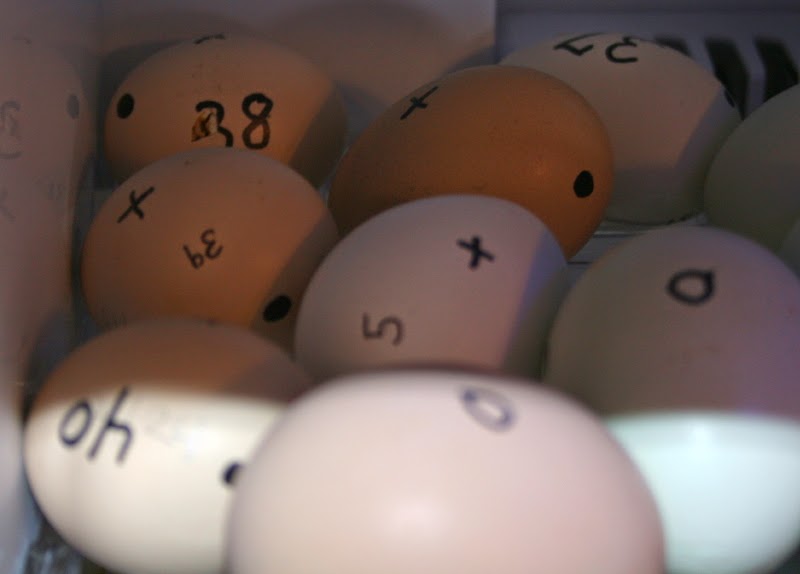
#38, top left, laid by Olive, our little gray bantam Cochin hen.  The other eggs surrounding it with the black dots on the end are the others due to hatch on Friday, #5, 36, 37, 39 and 40. I really hope it stops right where it is, since it should not be developed enough to survive at 18 days. You *need* 21 days to be fully cooked, ya dumb uppity banty!


And, you ask, is the brooder box ready? FUUUUUUCK NO. Now I have to grab lunch and sit and whack together a great huge box as fast as I can. If the chick hatches too early I'm bringing in Sophie, another little banty hen that went broody, and letting her mother it until more chicks hatch. Not starting the cam yet, I will if more eggs start to pip, though. I don't see Little Miss Fashionably Early Hellspawn unzipping yet, just the initial pip. The other eggs are rocking, though.

 What the HELL is with the chicken drama of some sort or another every freakin' year?!

EDIT:  Another bantam egg, #40, has pipped!  I went ahead and started the cam just in case one of them pops out overnight!

Saturday, March 7, 2015

I Can Stop Anytime!

No, I don't think I have a problem...


GUYS, I SWEAR I CAN STOP ANYTIME.


...OK, maybe not.

Hatch A and B are in the ReptiPro! I candled Hatch A last night, 19 Embryos for sure so far out of 43 eggs! There well might be more, it was hard to tell on some of the eggs, and some had REALLY dark shells. The shipped eggs seem to have a low viability count, but that's to be expected with shipped eggs. One of them has a detached air cell (thanks USPS for the rough handling).

But I did see for sure 7 embryos in the shipped eggs, 1 is an Americanaus mix, 3 are Easter Egger mixes 1 is possibly a Salmon Faverolle mix and and the other 3 possibly Cuckoo Marans mixes.

For our eggs, there are12 embryos: 3 Americaunas, 2 Barred Rock, one mystery egg and SIX banty eggs.

Pie (Rambo the buff Brahma's, daughter), Alice (the Barred Rock hen that we got as a nearly-dead, wounded freebie chick from Tractor Supply last year) and Olive (bantam Cochin) are all gonna be mommas!

I'm worried about Pie's egg though, it has a pretty significant dent in it that I sealed with clear nail polish...it didn't go through the membrane, just the shell...but we'll just have to see how it goes.

I'll candle again on Monday night and cull any eggs from Hatch A that haven't begun to develop, it'll be the 10 day mark for them. I'll candle all of the eggs on the 17th and cull again. I'll try and webcam both candlings, I'll also do it a bit earlier in the evening, probably around 9PM PST.

Hatch B ended up being 19 eggs, Jellybean laid an egg at the last minute yesterday so I added it!

Saturday, February 28, 2015

Hatch A Is Complete And Set!


This morning I added the final bunch of eggs, there are 43 in there right now!


When it comes to daddys, it could be any of the 7 roos, they are all being very diligent in their duties. There are two bantam roos--Bloop the MilleFleur Belgian d'Uccle and Mushroom the bantam Cochin. Big roos are: Weedcat, splash Giant Cochin, Cam, Giant Cochin/Ameraucaunas, Frosty and Cowbell, Ameraucaunas mix and Buzzard, Ameraucaunas/MilleFleur Belgian d'Uccle mix (I don't know how Bloop managed to climb Rose, a big hen, and father a child...but I salute him).

As for moms, the only eggs I was able to be sure of were 1 from Alice, Barred Rock, 1 from Sophie, Bantam Sicilian Buttercup/Cochin mix, 1 from Pie, Buff Brahma/Giant Cochin/Ameraucaunas mix and 1 from Olive, bantam Cochin. The green eggs are from Ameraucaunas hens and the other tiny eggs and from bantam hens...beyond that, who knows!

There are no eggs on the bottom of the ReptiPro because I'd have to raise the temps too high to get enough heat down there, eggs on the top shelf would get too hot and die. In one week I'll candle these guys and remove any that have not started to develop embryos, then add the eggs for Hatch B. As incubation progresses from there I'll candle the eggs again on March 14th and cull any non-developing eggs.

Now I get to hand-turn all these eggs 5 times a day for the next three weeks, haha.  Hatch A should hatch on March 20th & 21st.  Once the culls are out there will be a *bit* more room in there.

Friday, February 27, 2015

The Chickening Has Begun!

The first batch of hatching eggs is cookin' along in the ReptiPro!


This is 17 eggs--bantam eggs from our flock and the Polish mix eggs from the package I got the other day.  The rest of the eggs I'll set tomorrow morning for a total of 43 eggs.  I've decided to stagger the first hatch (there will be two if all goes well) so that the hatching is spread over two days, Friday March 20th and Saturday March 21st.  Admitedly this is an experiment, hopefully it'll work out and chicks will hatch over both days, giving more people a chance to see an actual chick hatching.  I'm trying to hatch the bantams and more delicate Polish birds first to give them a bit of a head start on the standard size chicks...some of which may well be Giant Cochin/Brahma mix gigantobeasts.

This will be Hatch A, due to hatch on March 20th & 21st.  I'll add more eggs for Hatch B in 7 days, when I candle the Hatch A eggs and cull any duds.  Hatch B will get candled 7-10 days after they are set to remove any undeveloped eggs from that batch. Hatch B should hatch March 27th & 28th if everything goes to plan.  All of the chicks should get along in one big brooder box just fine.

What you're looking at in this picture is the inside of our ReptiPro cabinet-type incubator--ReptiPros were originally made for herpetologists, then the chicken crowd came along and discovered that it worked great for bird eggs, too!  I have a friend who hatches emu eggs in one of these--although she can't get more than a few in there at once.

The shot glass in the bottom of the incubator provides moisture (chicken eggs need 50% humidity for the first 18 days of incubation, 65% for the final three days).  I keep two hygrometers in there, one dial type and the other the digital one on the top shelf.  The white cord on the left is a probe thermometer, the end is stuck into the child's toy (a water weasel), that gold thing on the left.  The water weasel simulates an egg, the probe thermometer gives you a reading of what the temp is inside of an egg, making for a better hatch! 

The eggs are numbered so that everyone can keep track of and cheer on their favorite once hatching begins.  They are also marked with an 'X' on one side and an 'O' on the other to help me keep track of which ones I've turned--since there is no automatic turner for this unit, I must hand-turn the eggs 5 times a day.  When I open the door of the unit to turn eggs, it also allows CO2 out and fresh O2 in.

The one drawback to the ReptiPro is that there is a fan running 24/7 that the chicks can hear inside the egg, so the minute they hatch they all stumble over to the stupid fan like it's their long-lost mama.

Makes for a very confusing first few hours of life, poor things!


Monday, April 21, 2014

Hatch D Is On!

Hatch D, our final hatch for 2014, has begun!  As usual, it's early...

For now the cam is still on the chicks in the brooder box until one of the eggs starts unzipping, probably in about 4-6 hours.

Hatch D has 11 eggs:  3 bantam Cochin eggs from the local high school, 4 dark green Bear eggs and 4 blue Americaunas eggs (either Bug or Rose for a mama).  Right now #11, a blue egg, has pipped--you can see it in the photo below, the egg behind the shot glass.  The pip is on the top left kinda towards the back.

We MAY have a broody mama for this batch if she is broody ENOUGH.  Wiggles, our blue mottled Belgian d'Uccle hen, is terrorizing the other chickens and stomping about all flared up and grumpy, but isn't setting yet.  If she starts setting and we don't get more than 4-5 chicks, we'll try her as mama.

Either way, we'll be partitioning off part of the brooder box for Hatch D since they will be so young--we don't want the older chicks trampling them.

Thursday, April 3, 2014

Hatch B Has Begun!

One of the Hatch B eggs, supposed to hatch on Saturday, has pipped!  Egg #15 (just behind #12) is a bit early.  It hasn't started to unzip yet, but when it starts we'll move the camera from the brooder box to the eggs in the incubator.


If this batch follows tradition the hatch will be early, likely starting tonight or early tomorrow.

Tuesday, April 1, 2014

April Fools!


The chicks (reluctantly) got into the spirit of the day and channeled their inner ballerina.

Really?  This is what you people do for entertainment?  HUMANS SUCK.
BadMr.Frosty was *not* amused.


Naughty chick upskirt pics!


NotASandwich never did turn around and face the camera.

We also raised the camera a bit to eliminate the incessant pecking it was suffering.  The chicks pouted.

I think the real problem was that it was in their TV watching spot.

Meanwhile, Hatch D was started in the incubator today, due to hatch April 22nd!

That's Hatch D on the top shelf, Hatch B & C on the lower shelf.
Hatch D consists of 3 itty bitty bantam Cochin eggs, kindly given to us by Douglas High School, 4 Bear eggs and 4 Americaunas eggs.  Hatch B is due to hatch this Saturday!

Saturday, March 15, 2014

Hatch B Is On It's Way!


Well, the 13 eggs of Hatch A are a week old, so this morning I started another 18 eggs for Hatch B!


Hatch B includes 2 Bantam Cochin (black parent birds, some chicks may be Frizzles) eggs obtained from a local breeder, 4 more dark green Bear eggs, 3 blue Americaunas, 3 light brown Brahma eggs (I think) and two other darker brown eggs from unknown moms.


The top shelf holds Hatch B, the bottom shelf Hatch A.  The next step will be to candle Hatch A on March 17th at the last turn for the night, around 11PM--it needs to be dark so I can see if anyone is in there--and any duds will be removed at that time.

Hatching dates should be March 29th for Hatch A, April 5th for Hatch B.  Once Hatch A has hatched and is in the brooder box, when Hatch B starts poppin' I'll section off a small part of the brooder box for them for a few days, after that I can remove the partition and all the little fluffballs can run together.  This should work to avoid the fresh chicks getting trampled.

Still no broodies yet, but that may change before Chickam begins!


Saturday, March 8, 2014

And We're Off For Year 6 of Chickam!


Twelve eggs were started in the ReptiPro incubator this morning!  The Saturday Chickam broadcast of the adult birds will continue until the hatch begins in 3 weeks, then it'll switch to the baby chicks and be running 24/7 for 8 weeks.


This batch includes three surprise eggs from Bear, our 12 year old Easter Egger Head Hen, who suddenly came back into lay this last week.  Cam, our youngster roo, has been cavorting shamelessly with her and must have triggered the old girl's hormones.  Egg #2 had a tiny hole in the shell which did not penetrate the membrane, so I stuck a bit of masking tape over it and am hoping for the best.  Whether or not any of Bear's eggs hatches will be a crap shoot due to Bear's age.

I'll be turning the eggs 5 times a day for the next three weeks, and will candle the eggs 7-10 days from now to see if chicks have developed...but I know from experience that Bear's eggs are too dark to see through so I won't know until hatch day if anyone is in there or not.  The purple thingy is a toy called a Water Weasel, I stick the probe of the digital thermometer in it--it mimics an egg and doing this gives you an idea of the temperature inside the eggs rather than of the air around them--it's more accurate and makes for a better hatch.  There are also two hygrometers to measure humidity in there, and the shot glass in the bottom holds a bit of water to maintain correct humidity.

Since I also plan on running a staggered hatch and placing a second batch of eggs in one week (you can do that with the ReptiPro), this batch is 'Hatch A' and are marked with a little 'A' at one end of the egg.  I'm hoping to acquire some Bantam Cochin eggs for Hatch B.

This batch also includes one lone Belgian d'Uccle banty egg for comic relief, I'm sure whatever else hatches will be a big honkin' chicken.  I can't reliably state beyond that which eggs came from which hens, although I know that our Giant Cochin girls tend to lay kinda pointed eggs rather than round ones.

Who is responsible for the weird purplish #4 & 5 eggs, I dunno.  I guess we'll see at hatch!

Monday, June 3, 2013

RIP, Brand New ReptiPro Incubator!

So...with one week to go before hatch, my new damned ReptiPro 6000 incubator failed spectacularly. It had been having problems holding temperature, dropping to 97 or shooting up to 102, despite being set at 100 degrees. The temperature fluctuations were becoming more and more frequent until two days ago, when it stopped heating altogether and instead chose to start making weird, electronic, 'gonna kill you in your sleep' smells.

I'd already contacted the ReptiPro folks and unfortunately they are out of stock until mid-June. Ack!

Time for a work-around!


Her name is Sonic and she's a Golden Laced Giant Cochin, she is a hatchmate of Yoya's and luckily went broody about 3 weeks ago. The 5 eggs from the incubator are under her now, it's all up to her for the next week. The only other alternative is the old styro incubator, but I trust Sonic over it as long as she doesn't abandon the eggs. With the way the ReptiPro had been freaking out, I don't hold out much hope that any of the eggs will hatch, but we'll see.

The only other alternative is me walking around with eggs in my bra for the next week.

Sonic passed the acid test today when she emerged from the box to eat, drink & poop (broody hen poops rival skunks for sheer stink power). After a few minutes I gently redirected her to the box...she eyed it warily, but spotted the eggs...and after a minute of disapproving clucking, reentered the box to sit on the eggs.

Atta girl, Sonic! The ReptiPro may have a cool blue light, but MY unit features growling & fluffiness as standard equipment. Not to mention it's an automatic egg turner!

And YES, I emailed this goddamn pic to the ReptiPro guy.

Thursday, April 18, 2013

Lockdown!

We've started the final three days! The brooder box is ready, as is the styrofoam incubator we'll have standing by as a chick-dryer-outer if we need it.


The eggs on the very bottom of the incubator are the current hatch. The eggs on the upper shelves are the next hatch, staggered for two weeks after this one.


The concentric rings are where I marked the progress of the air cells during incubation to make sure the eggs were on track. Usually I'd only do it 3-4 times, but with the new incubator I wanted to be extra cautious. The shot glass holds water to keep the humidity correct, and the little thing on the right is a hygrometer. The upper shelves have their own thermometer/hygrometer setup.

We've tested the cam and everything is as ready as it's going to get! When I did the final candling yesterday, I saw lively, squirmy chicks in all 15 of the eggs except two--these two may be late quitters, or merely fashionably late--I'm leaving them in the incubator to give them every chance. This morning one of the eggs peeped at my husband when he spoke to them, and wiggled energetically for me when I talked to them.

Saturday, March 30, 2013

GO!

We're off!


A total of 40 eggs were started in our new ReptiPro 6000 incubator this morning, if all goes well they should hatch Saturday, April 20th. There are 15 that I got from a local family in a fertile hatching egg trade, these breeds include light Brahma, Golden Polish and some mixed breed Polish, Buttercup, Silver Laced Wyandotte and Leghorn birds.


The remaining 25 eggs are from our hens.


The gray stuff along the front of each rack is some weatherstripping to keep eggs from rolling out.

I'd tried to line the racks with wire, but it ended up holding too much heat and making the temps go haywire, so I removed it.

I got a new hygrometer, in the back, top left. The purple thing is the water weasel which holds the temp probe, it simulates what the temp is inside an egg which is what you want. Dud eggs will be removed as incuabtion progresses.

All of the eggs have been numbered and look good. The weird round tracing on the large end of the eggs are the outline of the air cell--I'm changing my incubating technique radically and in addition to turning the eggs by hand 5 times a day (I have no life for the next 18 days) and candling them on days 7, 14 and 18 to make sure that they are losing the proper amount of weight (which is moisture--13% over 21 days), and will trace the new outline of the air cells on the eggs at that time--it'll end up looking a bit like the rings of a cut section of tree trunk. In addition I'll be weighing each rack of eggs every 3-4 days to make sure they are losing the correct percentage of weight. Between weighing the eggs and candling, you get a very good indication of how the eggs are doing--if the air cell is looking too large, the humidity is too low, if it is to small, the humidity too high.

So the hatch SHOULD be Saturday, April 20th. But given past years, the little buggers may well be a bit early or late according to Mother Nature's whim. If you go to the UStream Chickam page and see EGGS, it means the hatch is on!

The plan is for the ReptiPro to hatch the chicks, which will then immediately be removed to our old forced air styrofoam incubator to dry out & get strong. I'm going to try and get at least one of our girls to go broody so that she can take over the chicks once they are in the brooder box.

We will be testing the cam for a few minutes a couple of days prior to hatch just to make sure everything's working. We may also put the cam out in the yard with the adult chickens, our back yard is nearing completion and we may be allowing the chickens out of the run and into it for the first time.

Monday, March 25, 2013

Incubating High Tech Style, I'm DONE Dinkin' Around!

So the new ReptiPro 6000 incubator has arrived, and is being tested!


It has a blue interior light so it's gonna be kind of a baby chick rave:


The old styrofoam incubators just weren't cutting it up here, and the other day while being tested the forced air 'bator started to fluctuate temperature wildly.

That did it. Time to go high-tech.

So in doing days and days of online research and picking the brains of various fellow chicken owners, the ReptiPro was clearly the incubator of choice--actually a huge Sportsman cabinet model capable of hatching out several hundred eggs at a time was the way to go, but seeing as how those start at around $700 for the cheapo model, the ReptiPro was the saner choice. Having a small cabinet model like this takes our ambient humidity out of the equation, and this unit recovers after having the door opened to correct temp & humidity very quickly.

In testing my hygrometers I discovered that my fancy digital one was low by 22 points and even the el crappo dial one was low by 5 points. Neither can be adjusted, so we took ourselves off to the store and got a new digital hygrometer, which is being calibrated now.

Each shelf can comfortably hold 16 standard size eggs, although some people I know pile a LOT more eggs on and even stack them! I think for our first whack at hatching with this thing we'll go with 32 eggs to start, a mix of standard size and bantam eggs. I'm doing a fertile egg swap with another lady here in town so we hope to have some mixed breed Wyandottes, Buttercups and Polish chicks, too.

Incubating with this 'bator calls for me changing up my incubation technique pretty radically--running a drier incubation, turning eggs 5 times a day rather than 2, continuing to open the door 5x a day for ventilation right up to hatch--no 'lockdown'--and moving just-hatched chicks to the old styro incubators to dry out and get strong before they go into the brooder box. We'll remove chicks as they hatch so that they don't raise incubator humidity too much.

This is quite a departure for me, but what I used to do does NOT work up here, so I've gotta take a leap of faith and try this!

One of last year's chicks, a Red Star named Zipper, is thinking about going broody, but I don't know what kind of mama she'd be as a first-year hen. We'll see when April 20th rolls around if we have any volunteer mamas. Chickam should be interesting if all goes well...

Thursday, March 14, 2013

Testing, Testing...

Since we're going to be setting eggs to incubate on March 30th to hatch for our annual Chickam web broadcast on April 20th, I'm test running the incubators.


The chosen spot is back on top of my massively heavy kitchen island, in the dining room. The table we had them on last year transferred too much vibration from the floor, making the eggs jiggle suggestively and leading to false hopes for those eggs to hatch. NOTHING moves this thing, which is also good since it eliminates the danger of bumping the table and knocking over eggs you've been incubating for weeks.

I've been doing hours and hours of research online, reading scientific studies on hatching at high altitudes and picking fellow chicken breeders' brains for tips--last year our hatch was miserable and weird--we either had chicks hatching out 2 days early or 2-3 days late, and many chicks that died at day 19-20--they'd turned into hatching position but never did the internal pip of piercing the air cell. They'd been rocking their egg but then just died. When I did the after-incubation breakout of the unhatched eggs it was heartbreaking, and knowing that those healthy chicks got that close to hatching was frustrating.

I have gained some new insight and this year, although we weren't able to build the homemade incubator we want and are still using the old styrofoam 'bators, we will be making some drastic changes to our technique--things that absolutely wouldn't work at sea level we're going to have faith in here at 5000 feet in a dry climate. The hatching of an egg is a remarkably complex and delicate procedure and everything has to go just right.

Lower air pressure and drier air mean that we have to increase both humidity and ventilation--ideally pumping in extra oxygen would help during the last three days of incubation, but that isn't an option right now. Since we had chicks hatch early, I'm going to go against all instincts and lower the overall incubation temperature just a hair to about 99 to 99.5 degrees--no higher--we need to cook 'em slower! Last year we also had an overnight temperature spike of 106 degrees on hatch day, reason unknown. Also, getting the incubator humidity up to 65% for the final three days is nearly impossible up here. All the equipment is getting a thorough testing and calibration check.

We'll also make some more ventilation holes in the lids and bases of the incubators and buy some cap plugs so we can increase/decrease ventilation as needed.

I'm also hoping that using only high altitude eggs will make a big difference--trying to hatch sea level eggs at altitude makes for a poor hatch rate and lots of dead-in-shell, near term chicks. Sea level eggshells have larger pores and exchange O2/CO2 at a much greater rate than high altitude, smaller-pored eggshells do.

I had what I thought was a wild idea--somehow seal sea level eggs partway to balance the larger pore problem, possibly using a super thin coat of wax, strategically painted on in spots. Turns out someone else already tried it, with limited success, and wrote a scientific paper on it. I'm still kicking it around in my head as an artificial 'bloom' coat for hatching eggs, maybe with some other substance...

Meanwhile the girls are getting tons of vitamins, Omega oils, fresh dark leafy greens, protein & calcium to get the best eggs possible from them--last year they had only been here a couple of weeks and some of their eggshells at breakout were thin. Now we're getting lovely, healthy, strong eggs; the girls are happy and relaxed and the boys are doing their job. Who knows, maybe one of the girls will go broody and we'll have a mama for Chickam!

With my luck it'll be one of the HUGE hens and I'll have to make the brooder box accomodate a plus-size hen.